 Fisher bias#
This section shows how to map a systematic-induced shift in the data vector
into a parameter shift using derivkit.forecast_kit.ForecastKit.
The Fisher-bias workflow takes:
a Fisher matrix
F(typically fromderivkit.forecast_kit.ForecastKit.fisher())a difference data vector
delta_nu(systematic shift in observables)
and returns:
the Fisher-bias vector in parameter space \(b_a\)
the corresponding first-order parameter shift \(\Delta \theta_a\).
For a conceptual overview of Fisher bias, its interpretation, and other forecasting frameworks in DerivKit see Fisher Bias.
Note:
In practice, delta_nu is not constructed by
arbitrarily perturbing the observable vector. Instead it is obtained by
evaluating two model predictions at the same fiducial parameters: a baseline
model used in inference and a more complete model that includes the relevant
systematic(s). The Fisher-bias shift delta_theta then estimates how
the inferred parameters would move if data generated by the more complete
model were analyzed using the baseline model alone.
Compute delta_nu#
derivkit.forecast_kit.ForecastKit.delta_nu() computes a consistent 1D
difference vector. It accepts 1D arrays or 2D arrays (which are flattened in
row-major (“C”) order to match the package convention).
>>> import numpy as np
>>> from derivkit import ForecastKit
>>> np.set_printoptions(precision=8, suppress=True)
>>> # Define a simple toy model
>>> def model(theta0):
...     theta1, theta2 = theta0
...     return np.array([theta1, theta2, theta1 + 2.0 * theta2], dtype=float)
>>> # Fiducial parameters and covariance
>>> theta0 = np.array([1.0, 2.0])
>>> cov = np.eye(3)
>>> fk = ForecastKit(function=model, theta0=theta0, cov=cov)
>>> # Construct unbiased and biased data vectors
>>> data_unbiased = model(theta0)
>>> data_biased = data_unbiased + np.array([0.5, -0.8, 0.3])
>>> # Compute difference data vector Δν
>>> dn = fk.delta_nu(data_unbiased=data_unbiased, data_biased=data_biased)
>>> print(dn)
[ 0.5  -0.8   0.3]
>>> print(dn.shape)
(3,)
Compute Fisher bias and parameter shifts#
Use derivkit.forecast_kit.ForecastKit.fisher_bias() to compute the bias
vector and the corresponding parameter shift.
>>> import numpy as np
>>> from derivkit import ForecastKit
>>> np.set_printoptions(precision=8, suppress=True)
>>> # Define a simple toy model
>>> def model(theta0):
...     theta1, theta2 = theta0
...     return np.array([theta1, theta2, theta1 + 2.0 * theta2], dtype=float)
>>> # Fiducial setup
>>> theta0 = np.array([1.0, 2.0])
>>> cov = np.eye(3)
>>> fk = ForecastKit(function=model, theta0=theta0, cov=cov)
>>> # Compute Fisher matrix
>>> fisher = fk.fisher()
>>> # Build systematic difference vector
>>> data_unbiased = model(theta0)
>>> data_biased = data_unbiased + np.array([0.5, -0.8, 0.3])
>>> dn = fk.delta_nu(data_unbiased=data_unbiased, data_biased=data_biased)
>>> # Compute Fisher bias and parameter shift
>>> bias_vec, delta_theta = fk.fisher_bias(fisher_matrix=fisher, delta_nu=dn)
>>> print(bias_vec)
[ 0.8 -0.2]
>>> print(delta_theta)
[ 0.73333333 -0.33333333]
Using a specific derivative backend#
You can pass method and backend-specific options (forwarded to
derivkit.derivative_kit.DerivativeKit.differentiate()) for consistent
derivative control across Fisher and Fisher-bias calculations.
>>> import numpy as np
>>> from derivkit import ForecastKit
>>> np.set_printoptions(precision=8, suppress=True)
>>> # Define a simple toy model
>>> def model(theta0):
...     theta1, theta2 = theta0
...     return np.array([theta1, theta2, theta1 + 2.0 * theta2], dtype=float)
>>> theta0 = np.array([1.0, 2.0])
>>> cov = np.eye(3)
>>> fk = ForecastKit(function=model, theta0=theta0, cov=cov)
>>> # Compute Fisher matrix with finite-difference backend
>>> fisher = fk.fisher(method="finite", stepsize=1e-2, num_points=5, extrapolation="ridders", levels=4)
>>> # Construct difference data vector
>>> dn = fk.delta_nu(
...     data_unbiased=model(theta0),
...     data_biased=model(theta0) + np.array([0.5, -0.8, 0.3]),
... )
>>> # Compute Fisher bias using the same backend
>>> bias_vec, delta_theta = fk.fisher_bias(
...     fisher_matrix=fisher,
...     delta_nu=dn,
...     method="finite",
...     stepsize=1e-2,
...     num_points=5,
...     extrapolation="ridders",
...     levels=4,
... )
>>> print(bias_vec)
[ 0.8 -0.2]
>>> print(delta_theta)
[ 0.73333333 -0.33333333]
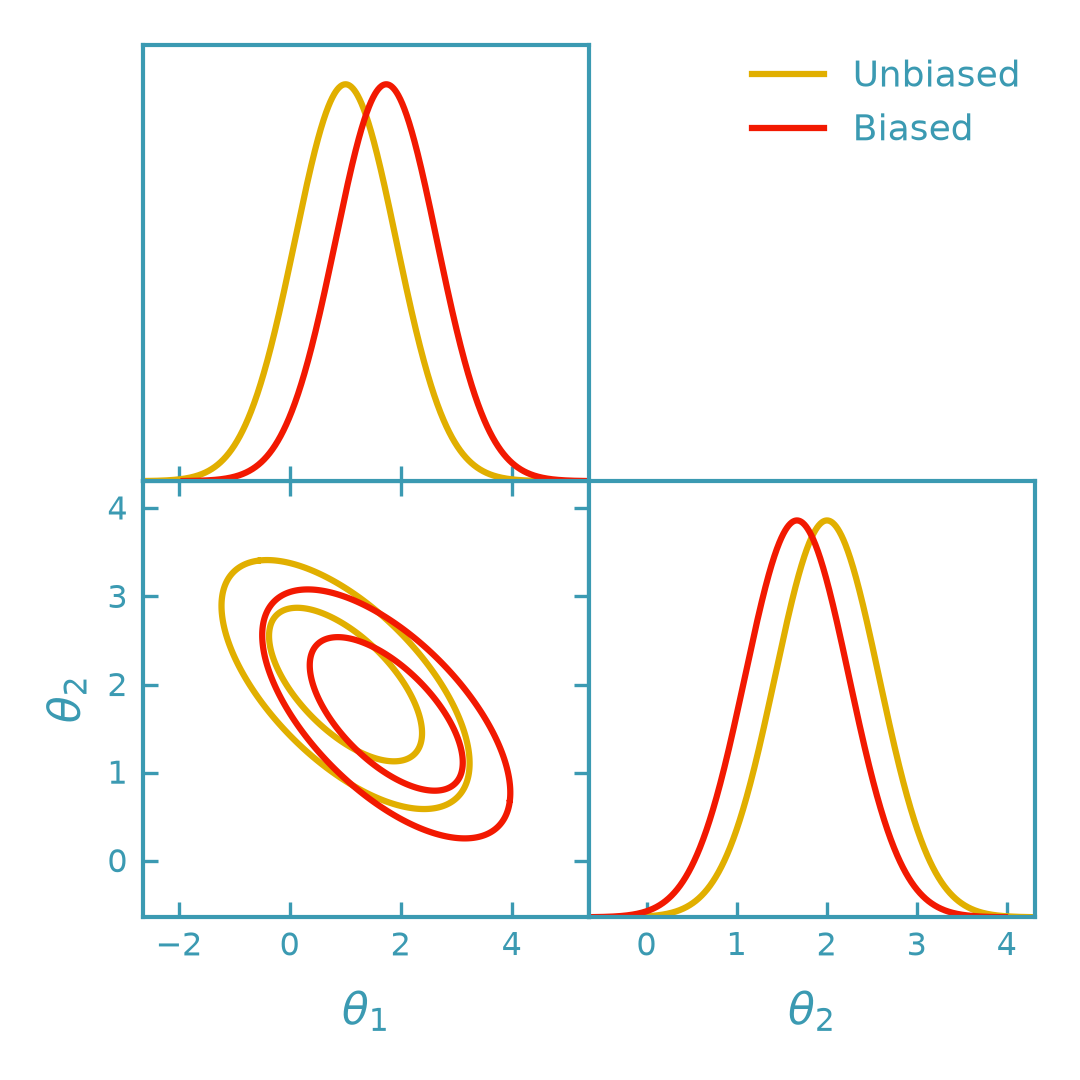
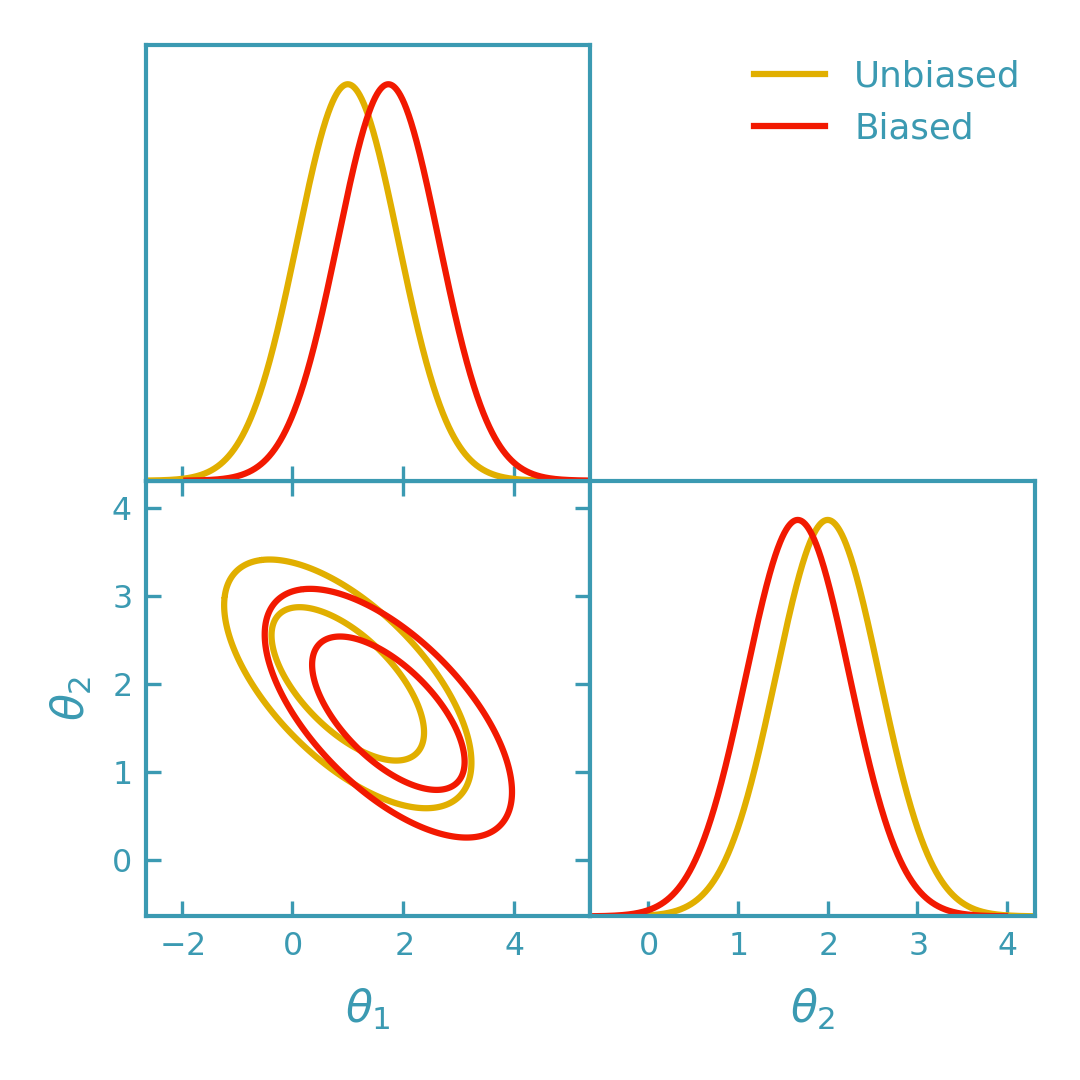
Fisher bias contours with GetDist#
You can visualize the impact of a systematic as a shift of the Fisher forecast
contours: plot the original Fisher Gaussian at theta0 and the biased one at
theta0 + delta_theta (same covariance, shifted mean).
>>> import numpy as np
>>> from getdist import plots as getdist_plots
>>> from derivkit import ForecastKit
>>> np.set_printoptions(precision=8, suppress=True)
>>> # Define a simple toy model
>>> def model(theta0):
...     theta1, theta2 = theta0
...     return np.array([theta1, theta2, theta1 + 2.0 * theta2], dtype=float)
>>> # Fiducial parameters and covariance
>>> theta0 = np.array([1.0, 2.0])
>>> cov = np.eye(3)
>>> # Unbiased ForecastKit at theta0
>>> fk = ForecastKit(function=model, theta0=theta0, cov=cov)
>>> # Fisher at theta0 (baseline curvature)
>>> fisher = fk.fisher(method="finite", extrapolation="ridders")
>>> # Construct difference data vector
>>> data_unbiased = model(theta0)
>>> data_biased = data_unbiased + np.array([0.5, -0.8, 0.3])
>>> dn = fk.delta_nu(data_unbiased=data_unbiased, data_biased=data_biased)
>>> bias_vec, delta_theta = fk.fisher_bias(fisher_matrix=fisher, delta_nu=dn)
>>> # Biased ForecastKit: same model+cov, shifted mean theta0 + delta_theta
>>> fk_biased = ForecastKit(function=model, theta0=theta0 + delta_theta, cov=cov)
>>> # Convert to GetDist Gaussians (means come from fk.theta0 and fk_biased.theta0)
>>> gnd_unbiased = fk.getdist_fisher_gaussian(
...     fisher=fisher,
...     names=["theta1", "theta2"],
...     labels=[r"\theta_1", r"\theta_2"],
...     label="Unbiased",
... )
>>> gnd_biased = fk_biased.getdist_fisher_gaussian(
...     fisher=fisher,
...     names=["theta1", "theta2"],
...     labels=[r"\theta_1", r"\theta_2"],
...     label="Biased",
... )
>>> # Plot biased and unbiased contours
>>> dk_red = "#f21901"
>>> dk_yellow = "#e1af00"
>>> line_width = 1.5
>>> plotter = getdist_plots.get_subplot_plotter(width_inch=3.6)
>>> plotter.settings.linewidth_contour = line_width
>>> plotter.settings.linewidth = line_width
>>> plotter.settings.figure_legend_frame = False
>>> plotter.triangle_plot(
...     [gnd_unbiased, gnd_biased],
...     params=["theta1", "theta2"],
...     legend_labels=["Unbiased", "Biased"],
...     legend_ncol=1,
...     filled=[False, False],
...     contour_colors=[dk_yellow, dk_red],
...     contour_lws=[line_width, line_width],
...     contour_ls=["-", "-"],
... )
>>> bool(np.all(np.isfinite(delta_theta)))
True
(png)
Notes#
delta_nucorresponds to the difference data vector \(\Delta \nu = \nu^{\mathrm{biased}} - \nu^{\mathrm{unbiased}}\), evaluated consistently with the covariance. Notice the convention and sign as the interpretaton of the results depend on it.The Fisher bias approximation is local: derivatives are evaluated at
theta0.The returned
delta_thetais the first-order parameter shift implied by the systematic difference vector.All examples in this section use mock data and toy systematics for illustration only. The injected
delta_nuand the resulting Fisher bias are arbitrary and chosen to produce a visible parameter shift. In a real analysis,delta_nushould be derived from a physically motivated systematic model evaluated consistently with the data vector and covariance.